
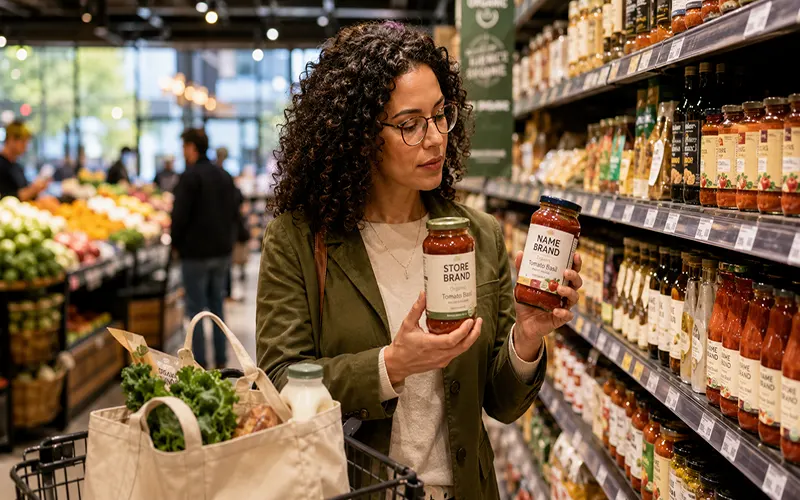
In the modern retail landscape, the choice between a name-brand product and a store brand has evolved from a simple budget calculation into an exercise in consumer intelligence. The “Quality Gap Myth”—the belief that store brands are inherently inferior—has been dismantled by retailers who now treat their private labels as a cornerstone of their brand identity. For the analytical shopper, the goal is no longer to guess which products might be good, but to use a systematic, data-driven approach to identify the highest-quality alternatives on the shelf.
The Supply Chain Detective
To identify premium store-brand alternatives, you must think like a supply chain analyst. Most large retailers do not manufacture their own goods; they contract with co-packers. You can often uncover these partnerships by looking at the “Distributed By” or “Manufactured For” lines on the product packaging.
If you recognize a manufacturer or a facility location that also produces premium national brands, you have identified a high-probability “quality match.” Many retailers use the same high-standard co-packers as the market leaders. If the facility location matches that of a top-tier brand, the quality parity is almost guaranteed, as the same safety protocols, ingredient sourcing, and quality control systems are likely in play.
The “Clean Label” Test: Evaluating Formulations
A sophisticated shopper knows that an ingredient list is a window into the manufacturer’s cost structure and quality philosophy. When comparing a store brand to a name brand, perform the “Clean Label” test:
- Filler Analysis: Look for unnecessary additives, fillers, or artificial dyes. High-quality store brands, especially those in “organic” or “premium” private-label tiers, often utilize cleaner formulations than their lower-tier generic counterparts.
- Active Ingredient Concentration: For cleaning products or personal care items, check the concentration of the primary active ingredient. If the store brand lists the same concentration of active surfactants or chemicals as the name brand, the efficacy is likely identical.
- Source Transparency: Premium private labels are increasingly transparent about sourcing, often highlighting the origin of core ingredients (e.g., “Extra Virgin Olive Oil from Italy” vs. “Blend of oils”). High-quality alternatives prioritize this transparency to build trust.
Distinguishing the Private Label Tiers
Retailers have moved toward a tiered strategy to capture different segments of the market. Understanding these tiers is essential for identifying high-quality items:
- Budget Tier: Often identified by plain, white-label packaging. These are price-focused and may use lower-cost ingredients to minimize expense.
- Standard Private Label: The store’s flagship house brand. These are typically designed to match the quality of leading national brands.
- Premium/Signature Tier: These lines (often branded with names like “Reserve,” “Select,” or “Organic”) are designed to outperform name brands. They frequently feature better sourcing, artisanal production methods, and superior packaging.
When shopping, prioritize the Premium/Signature tier. These products are the retailer’s “loss leaders” in terms of reputation; they are designed to prove that the store can offer better quality than established competitors.
Packaging as a Proxy for Quality
While you should never judge a book by its cover, in the retail world, packaging design is a strong indicator of investment. High-quality store brands now mirror the packaging standards—and often the innovations—of national brands. Look for:
- Functionality: Is the packaging resealable, ergonomic, or moisture-proof? Retailers who invest in functional, durable packaging are almost always investing equally in the quality of the product inside.
- Design Intent: A product presented with professional typography, clear usage instructions, and robust recycling information suggests a manufacturer that is confident in its product’s value proposition.
Data-Driven Shopping Techniques
Leverage the retailer’s own infrastructure to validate your choices:
- Retailer Loyalty Data: Major chains use internal data to identify which name-brand items are top-sellers and then create a store-brand equivalent to match that specific profile. Use the retailer’s website reviews—specifically the verified purchase reviews—to see if the store brand is successfully replicating the experience of the name brand.
- Satisfaction Guarantees: Use the store’s return policy as a risk-free trial. If a retailer offers a “satisfaction guaranteed or your money back” promise on their private label, they are essentially underwriting the risk of your experiment. Use this to test products without financial loss.
The 5-Step Quality Validation Checklist
Use this quick checklist while in the aisle to validate any potential store-brand swap:
- Verify the Manufacturer: Check the “Distributed by” address; does it align with a known premium manufacturer?
- Audit the Ingredient List: Compare it against the name brand. Are there added fillers or lower-quality substitutes?
- Evaluate the Tier: Is this the “budget” option or the “premium/signature” option? Opt for the latter.
- Check the Physical Packaging: Is it as durable and functional as the name brand?
- Scan for Guarantees: Does the retailer explicitly stand behind the quality of this house brand?
Identifying high-quality store-brand alternatives is a skill that shifts your role from a passive consumer to an active, informed participant in the market. By applying these diagnostic strategies—tracing supply chains, analyzing ingredients, and leveraging retailer tiers—you remove the guesswork from your shopping trip. This systematic approach ensures that every swap you make is a calculated upgrade, ultimately resulting in a more efficient, higher-quality, and cost-effective household operation.