

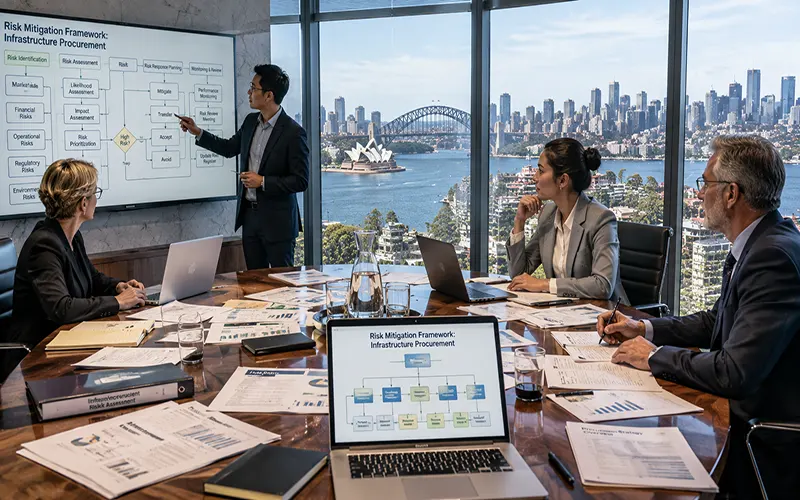
In the realm of critical infrastructure—spanning power grids, heavy manufacturing, and transportation networks—capital procurement is a high-stakes discipline. Unlike standard commercial purchasing, capital procurement for infrastructure involves long lead times, specialized engineering requirements, and assets that are designed to operate for decades. When the supply chain for these critical components falters, the resulting downtime is not merely an inconvenience; it is a systemic failure that can impact public safety, economic stability, and national security.
Managing these risks requires moving beyond traditional procurement models toward a framework of Resilient Procurement.
The Anatomy of Infrastructure Risk
To manage risk, one must first categorize it. Critical infrastructure procurement is uniquely vulnerable to three primary vectors:
- Geopolitical and Macroeconomic Instability: Infrastructure projects are often reliant on raw materials (such as lithium, copper, or steel) that are concentrated in specific regions. Trade tariffs, regional conflicts, or port congestion can turn a stable supply chain into a bottleneck overnight.
- Technical Dependency and Obsolescence: Many critical assets rely on proprietary, specialized hardware or software. A “Single-Point-of-Failure” occurs when a project relies on one niche supplier for a mission-critical controller or component. If that supplier folds or shifts strategy, the entire infrastructure asset can become unmaintainable.
- Tier-N Supplier Blindness: Most project managers have visibility into their direct (Tier 1) suppliers. However, risk often resides deeper in the supply chain (Tier 2 and Tier 3). If a Tier 1 manufacturer of industrial automation systems relies on a single sub-tier foundry for microchips, the project’s timeline is effectively held hostage by that obscure sub-supplier.
Strategic Risk Mitigation Framework
The transition from a “Just-in-Time” (JIT) model—which prioritizes cost-efficiency—to a “Just-in-Case” (JIC) model is essential for critical infrastructure.
- Strategic Redundancy (Dual/Multi-Sourcing): While multi-sourcing can increase administrative overhead, it is a necessary insurance policy. By qualifying at least two geographically distinct suppliers for every mission-critical component, organizations create the agility to pivot if one region experiences a disruption.
- Strategic Stockpiling: For long-lead assets (such as high-voltage transformers or custom gearboxes), organizations should maintain a strategic buffer of critical spare parts. While this ties up capital, the cost of a six-month delay in a multi-million-dollar project vastly outweighs the carrying cost of inventory.
- Nearshoring and Reshoring: Diversifying the geographic footprint of your supply base is the most effective hedge against logistics transit risks. By sourcing from stable, closer regions, firms reduce their reliance on complex, long-haul international logistics chains.
Advanced Risk Management Tools
Modern procurement must leverage data to move from reactive fire-fighting to proactive planning:
- Digital Twins and Predictive Analytics: Create a “Digital Twin” of the supply chain to model how a failure in a specific sub-supplier or logistics hub would ripple through to the final installation date. AI-driven predictive analytics can now scan geopolitical news and logistics data to provide early warnings of potential delays.
- Contractual Safeguards: Procurement contracts must be viewed as risk-management documents. They should include robust force majeure clauses, clear penalty structures for delivery delays, and—crucially—clauses that grant the buyer visibility into the supplier’s own sub-tier supply chain.
Regulatory and Cybersecurity Vigilance
Critical infrastructure is increasingly digitized, meaning the supply chain now carries a significant cyber-risk. Every sensor, controller, or IoT gateway integrated into an asset is a potential entry point for a threat actor. Procurement teams must vet suppliers not just for financial stability, but for adherence to stringent cybersecurity standards. Furthermore, ESG (Environmental, Social, and Governance) compliance is no longer optional; supply chains that fail to meet these standards face increasing regulatory and reputational risk, which can lead to project shutdowns or asset disqualification.
The Culture of Resilience
The most sophisticated tools will fail if the organization treats procurement as a siloed function. True resilience requires a cross-functional Capital Procurement Council consisting of:
- Procurement: To manage market intelligence.
- Engineering: To validate the technical feasibility of alternative components.
- Finance: To approve the higher upfront costs of redundant supply chains.
- Legal: To enforce risk-mitigation contracts.
By aligning these groups, an organization ensures that risk management is an operational discipline rather than an emergency-response task performed only after a shipment has been delayed.
Executive Action Items
- Conduct a Supply Chain Audit: Map your supply chain down to the Tier-3 level for all mission-critical capital equipment.
- Define Criticality: Identify which items would cause a catastrophic project delay and prioritize them for multi-sourcing.
- Invest in Data: Allocate budget toward digital visibility tools that offer real-time tracking of Tier-1 and Tier-2 suppliers.
In critical infrastructure, the cost of a delay usually far outweighs the cost of a more resilient, higher-priced procurement strategy. Moving toward a model of Resilient Procurement requires a fundamental shift in how leadership views its supply chain—from a cost center to be minimized, to a strategic asset to be protected. By institutionalizing risk management through geographic diversification, data-driven modeling, and cross-functional oversight, organizations can ensure that their critical capital assets are delivered on time, within spec, and ready for decades of service.