

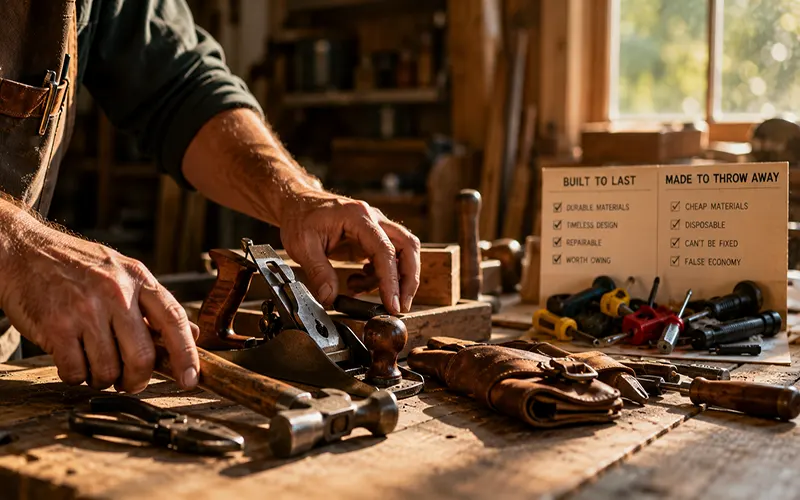
In a world driven by “fast consumption,” we are conditioned to believe that lower upfront costs equate to better financial decisions. We buy plastic kitchen tools, particleboard furniture, and disposable electronics, only to replace them within a few years. This cycle is a “false economy.” A $20 item that must be replaced annually is significantly more expensive than a $100 item that lasts for a decade. By shifting our perspective to cost-per-use, we can break the cycle of disposable consumption and build a life around items that pay for themselves through sheer longevity.
The Material Science of Durability
To stop wasting money on low-quality goods, you must learn to identify the physical characteristics of durability. When shopping, prioritize these “Green Flags”:
- Metals: Cast iron, stainless steel, and brass are the gold standards. They withstand heat, impact, and wear.
- Textiles: Look for natural, high-density fibers like full-grain leather, heavy-weight wool, or canvas. Avoid “vegan leather” (which is often just plastic) or synthetic blends that fray under pressure.
- Construction: Seek out full-tang knives (where the blade metal extends through the handle), bolted connections instead of glued ones, and mechanical components that can be disassembled and cleaned.
Essential Categories for “Buy-It-For-Life” (BIFL) Upgrades
When you are ready to replace a worn-out item, upgrade to a durable version using these categories as your guide:
Kitchen
- Cast Iron Skillets: These can literally last generations. They are naturally non-stick when seasoned and are virtually indestructible.
- High-Carbon Steel Knives: Unlike cheap stamped steel that dulls in weeks, high-quality forged steel knives hold an edge for years and can be resharpened indefinitely.
- Glass and Stainless Steel Storage: Plastic containers stain, retain odors, and crack. Glass and steel are inert, dishwasher-safe, and outlast plastic by a magnitude of ten.
Home and Office
- Solid Wood Furniture: Avoid particleboard or MDF, which swell and crumble when exposed to moisture. Solid wood can be sanded, refinished, and repaired for decades.
- Mechanical Keyboards: Most office keyboards are membrane-based and designed to fail. A mechanical keyboard is modular; switches can be replaced, and the housing is usually reinforced to endure millions of keystrokes.
Personal Gear and Tools
- Goodyear-Welted Boots: This construction method allows a cobbler to remove and replace the sole when it wears out, essentially giving you a “new” boot without having to discard the leather upper.
- Metal-Bodied Flashlights: Plastic flashlights are prone to internal circuit failure and case cracking. A machined aluminum body with a simple, high-quality LED driver is a tool for life.
How to Spot “Planned Obsolescence”
Retailers often design products to fail, a practice known as planned obsolescence. Avoid items that exhibit these “Red Flags”:
- Glued/Sealed Battery Compartments: If you cannot replace the battery, the device is essentially a disposable object with a shelf life.
- Proprietary Fasteners: If you need a specialized, non-standard screwdriver to open the casing, the manufacturer is actively preventing you from repairing it.
- Excessive Plastic Housing: If the primary structural integrity of a device relies on thin, injection-molded plastic, it will eventually become brittle and shatter.
The Repairability Principle
The hallmark of a truly durable product is that it can be fixed. Before purchasing an expensive item, ask one question: Can I find replacement parts for this in five years?
Seek out brands that provide schematics, sell individual screws or parts, and offer lifetime warranties. If a company stands behind their product for life, their financial incentives are aligned with yours—they want the product to last because it saves them the cost of a warranty claim.
The Transition Plan: A Sustainable Strategy
You do not need to discard your current belongings to start living an investment-focused lifestyle.
- The “Wait-to-Replace” Method: Keep using what you have until it breaks. Only when the item fails—and you have confirmed that repairing it is not cost-effective—should you upgrade to a BIFL version.
- The Thrift Advantage: High-quality goods of the past were often over-engineered. Vintage cast iron, older hand tools, and solid wood furniture from second-hand shops can often be found for a fraction of the cost of new, cheap items.
| Metric | Disposable Item ($10) | BIFL Item ($100) |
| Lifespan | 1 Year | 10+ Years |
| Total 10-Year Cost | $100 | $100 |
| Waste Generation | High (10 units) | Minimal (1 unit) |
| Performance | Degrading | Consistent |
Transitioning to durable, everyday products is one of the most effective ways to lower your cost of living while reducing your environmental footprint. By shifting your perspective from the “low price tag” to the “cost-per-use,” you stop viewing spending as a loss of capital and start viewing it as an investment in ownership. The items you buy should serve you for years to come—choose the ones that are built to honor that commitment.


