

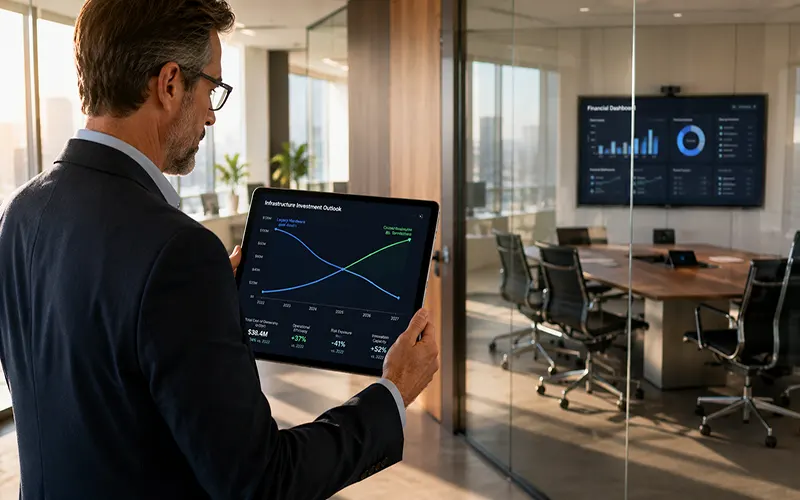
For decades, IT infrastructure was synonymous with tangible assets. CTOs and CFOs lived in the cycle of procurement: estimating three-to-five years of compute needs, securing massive budget allocations for server arrays and data center cooling, and then depreciating those assets over their useful life. This is the CapEx (Capital Expenditure) model.
Today, the industry is undergoing a fundamental financial evolution. As enterprises pivot toward cloud-native architectures, the core of IT spending is shifting from owning hardware to consuming infrastructure as a service (IaaS). This transition from CapEx to OpEx (Operating Expenditure) is not merely a change in accounting; it is a shift from rigid asset ownership to fluid, agile consumption.
The Case for CapEx (The Old Guard)
It is important to acknowledge why the CapEx model persisted for so long. For organizations with highly predictable workloads and stringent data sovereignty requirements, owning the iron offers:
- Cost Predictability: Once the hardware is paid for, the primary ongoing costs are electricity and maintenance.
- Total Control: You dictate every aspect of the hardware stack, from the chipset to the firmware, which is vital for some regulated industries or niche performance computing.
However, in a digital economy defined by rapid innovation, these benefits are increasingly outweighed by the rigidity they impose.
The Strategic Benefits of the OpEx Shift
The move to a cloud-based OpEx model replaces the “purchase-and-depreciate” lifecycle with a “pay-as-you-go” utility model. This offers three transformative advantages:
- Scalability and Elasticity: The cloud allows enterprises to scale resources up or down in real-time. You no longer need to over-provision hardware to handle “peak” traffic that only occurs once a year. You pay only for what you consume, turning infrastructure into a dynamic utility.
- Financial Agility: In an OpEx model, IT costs move directly to the P&L as a monthly service fee. This aligns spending directly with revenue-generating activities. When a product launch succeeds and traffic surges, your infrastructure costs increase proportionally—but only for as long as they are needed.
- Elimination of the Refresh Cycle: With cloud infrastructure, the “burden of obsolescence” shifts to the cloud provider. You no longer manage the decommissioning, recycling, or complex migration of physical server racks every few years. You are always running on modern, optimized infrastructure.
Managing the Transition: The CFO’s Concern
The transition to OpEx is not without friction. CFOs often express concern over the lack of “fixed” costs, fearing that cloud consumption could spiral out of control.
- The “Double Bubble”: During migration, most companies experience a “double bubble” where they must continue to fund legacy hardware while simultaneously ramping up cloud spending. This transition requires rigorous financial planning to ensure that decommissioning schedules are synchronized with cloud adoption milestones.
- Runaway Costs (Cloud Sprawl): Without oversight, it is easy for development teams to leave idle instances running. This is where the discipline of FinOps—the practice of bringing financial accountability to the variable spend model of the cloud—becomes essential.
Critical Operational Shifts
Shifting to an OpEx model requires your team to abandon old habits:
- From Asset Management to Usage Monitoring: Your IT team should no longer focus on the “health” of a physical hard drive, but rather on the “efficiency” of cloud consumption. Real-time observability is now your most important asset management tool.
- The FinOps Mandate: Successful cloud adoption requires a cultural change. Implementing a FinOps team ensures that engineers are aware of the costs of their architectural decisions. It moves the conversation from “Does this work?” to “Does this provide the best value for the cost?”
The “Cloud-Hybrid” Middle Ground
It is a mistake to believe that every asset must be in the public cloud. Many large enterprises adopt a Hybrid Cloud strategy, keeping mission-critical, stable-workload core systems on-premises (CapEx) to maximize cost-efficiency, while utilizing the public cloud (OpEx) for scalable, customer-facing applications. This allows firms to balance the stability of owned infrastructure with the agility of the cloud.
The shift from physical hardware CapEx to cloud-based OpEx is a permanent evolution in how enterprises build and fund technology. While the OpEx model demands a new, rigorous level of real-time financial oversight and FinOps governance, the trade-off is a level of agility that was previously impossible. Organizations that master this financial transition will be the ones that can pivot fastest in a market that demands constant, scalable innovation. Infrastructure is no longer an asset to be managed; it is a capability to be harnessed.